RDL Hospital Nurse Calling System
Real-Time Patient Calling, Nurse Response & Hospital Alerting
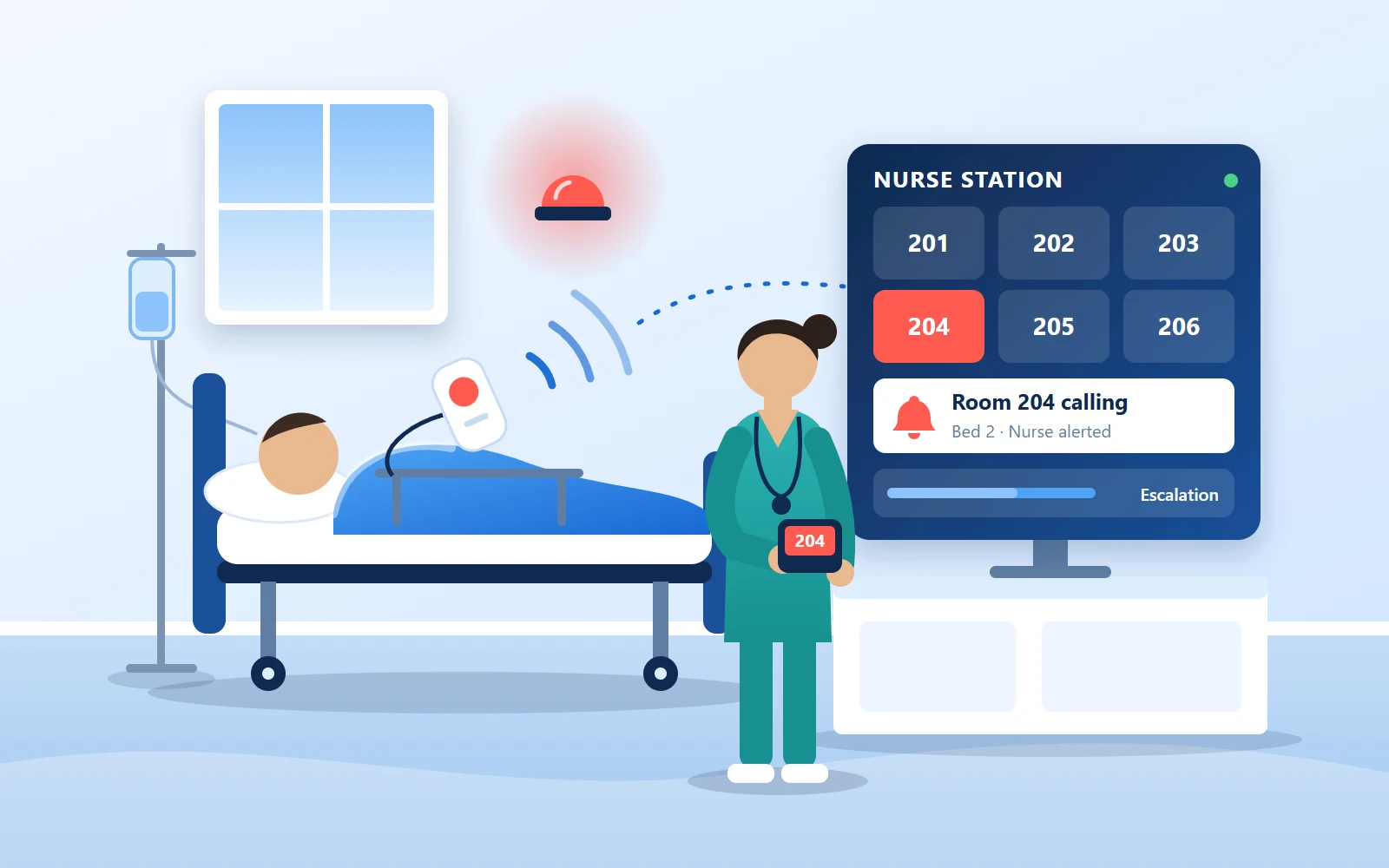
RDL Hospital Nurse Calling System improves patient care, reduces response time and enhances hospital-wide visibility by combining patient call buttons, visual indicators, audio alerts and centralized digital dashboards.
The system enables patients to quickly request assistance while allowing nurses, supervisors and hospital management to respond efficiently and monitor service response across wards, rooms and departments.
Key Challenges Addressed
Hospitals often face the following patient-assistance challenges
 Delayed Nurse Response - Patients may experience delays when requesting assistance from nursing staff. Lack of Real-Time Visibility - Nursing supervisors may not have a centralized view of active patient calls and pending requests. Manual Escalation Gaps - Unattended calls can remain unresolved without systematic escalation. Inefficient Call Management - Manual tracking makes it difficult to measure nurse response and patient service performance. Emergency Response Challenges - Critical patient assistance requests require immediate visibility and prioritization.
Solution Highlights
From Patient Call to Nurse Response - A Complete Care Response Loop
 Real-Time Patient Alerts - Instant visual and audio alerts when a patient requests assistance. Multi-Level Escalation - Configurable escalation from nurse station to senior nurse, supervisor or designated hospital personnel when a call is not acknowledged. Room & Bed Identification - Clearly identifies the hospital room, bed and patient location associated with the call. Centralized Dashboard - Live visibility of active, acknowledged, attended and pending calls across wards and departments. Emergency / Code Alerts - Dedicated emergency call functionality for critical situations requiring immediate attention. Response Analytics - Historical analysis of response time, call frequency, pending calls and nursing-service performance. Integration Ready - Can be designed for integration with hospital information systems, nurse stations, displays and other hospital communication systems.
Core System Components
 Patient Call Unit
Installed near the patient bed for easy access.
● Patient nurse-call push button
● Emergency call option
● Cancel / reset functionality
● Bed-level call identification
● Visual call indication
● Suitable for patient rooms and wards
 Nurse Call Unit
Installed at the nurse station or nursing counter.
● Real-time patient call display
● Room and bed identification
● Call acknowledgement
● Call cancellation / reset
● Audio and visual notification
● Pending-call visibility
 Corridor / Room Display
Provides clear visual indication of active calls.
● Room / bed identification
● Call status indication
● Normal, assistance and emergency call indication
● High-visibility display
● Suitable for wards and corridors
 Audio Alert System
Provides audible notification for active patient calls.
● Configurable alert tones
● Different tones for normal and emergency calls
● Audible notification at designated nursing locations
● Supports faster identification of priority calls
 Central Monitoring Dashboard
Provides centralized visibility of nurse-call activity.
● Live ward status
● Active call monitoring
● Pending call monitoring
● Acknowledged and attended calls
● Response-time monitoring
● Historical reports
● Ward-wise and department-wise analytics
How It Works
Patient Requests AssistanceThe patient presses the nurse-call button installed near the bed.
Instant AlertThe corresponding room and bed information is immediately displayed at the nurse station and/or designated displays.
Nurse AcknowledgementThe assigned nurse acknowledges the request and proceeds to the patient’s location.
Call AttendanceThe nurse attends to the patient’s requirement.
Call ClosureThe call is reset/closed after assistance is provided.
EscalationIf a call remains unattended beyond a configured time, the system can escalate the alert to the next responsible person.
AnalyticsCall and response information is stored for monitoring, reporting and continuous improvement.
Hospital-Wide Monitoring
The system can provide a centralized view of patient call status, room and bed status, active calls, emergency calls, acknowledged calls, pending calls, attended calls, response time, ward-wise performance, nurse station status and historical call records.
Patient call status Room and bed status Active calls Emergency calls Acknowledged calls Pending calls Attended calls Response time Ward-wise performance Nurse station status Historical call records This enables hospital management to monitor the overall patient assistance and nursing response process from a centralized location.
Escalation Management
The system can support configurable escalation levels, based on the type and priority of the patient request.
Emergency Call Management
Dedicated emergency functionality can be provided for situations requiring immediate nursing attention.
Displayed with priority indication Accompanied by distinct audio alerts Highlighted on centralized dashboards Escalated to designated personnel Recorded for subsequent analysis Digital Dashboard & Analytics
The centralized dashboard can provide real-time and historical information
 Live Monitoring
● Active patient calls
● Emergency calls
● Pending calls
● Acknowledged calls
● Attended calls
 Performance Analytics
● Average nurse response time
● Ward-wise response performance
● Call frequency
● Peak calling periods
● Pending-call analysis
● Emergency-call statistics
● Shift-wise performance
 Reports
● Daily call report
● Ward-wise call report
● Nurse response report
● Emergency call report
● Response-time report
● Historical trend analysis
Retrofit & Deployment Ready
The solution can be designed for deployment in:
The original RDL Andon architecture is designed to work with existing environments, including older equipment and manual workstations; the equivalent nurse-call implementation can follow the same retrofit-oriented approach.
Connectivity & Integration
The system architecture can support wired or wireless communication depending on hospital requirements.
The original RDL solution uses communication technologies including Modbus, MQTT, JSON and secured communication, with edge gateways used to consolidate field data and communicate with the application server.
For a hospital deployment, the exact communication protocol and cybersecurity architecture should be finalized based on the hospital’s infrastructure and system requirements.
Key Benefits
 Faster Patient Assistance
Reduces the time between a patient request and nurse awareness.
 Improved Patient Safety
Provides immediate visibility of assistance and emergency requests.
 Centralized Monitoring
Enables nursing supervisors and hospital management to monitor calls across wards.
 Reduced Manual Tracking
Automatically records call events and response information.
 Better Accountability
Provides measurable response-time and service-performance information.
 Data-Driven Improvement
Historical analytics help identify recurring issues and improve nursing workflows.
 Scalable Architecture
Can be expanded from a single ward to multiple floors, departments or hospital locations.
Typical Application Areas
Centralized Hospital Command View
The Nurse Calling System can provide a consolidated real-time view across multiple wards and nursing stations.
This creates a centralized patient-assistance monitoring loop and enables faster decision-making.
Continuous Improvement
Historical nurse-call data can be analyzed to identify:
This information can support hospital management in improving staffing, workflows and patient-service quality.
Conclusion
RDL Technologies can extend its real-time monitoring and alerting capabilities from industrial environments to hospital patient-care and nurse-response applications. By combining patient call buttons, visual indicators, audio alerts and centralized digital dashboards, the RDL Hospital Nurse Calling System helps hospitals reduce response time, improve patient safety and gain measurable visibility across wards and departments.
This solution supports Smart Hospital initiatives and digital transformation, making it a valuable tool for modern healthcare facilities.