Industrial Training Management System - ITMS

Digital Workforce Training, Competency & Certification Management
In modern manufacturing organizations, workforce competency is directly linked to productivity, quality, safety, compliance and operational excellence. However, many organizations still manage employee training through Excel sheets, paper records, emails and disconnected Learning Management Systems.

This creates challenges in identifying skill gaps, tracking mandatory training, managing certifications, monitoring competency levels and ensuring that only qualified personnel perform critical operations.

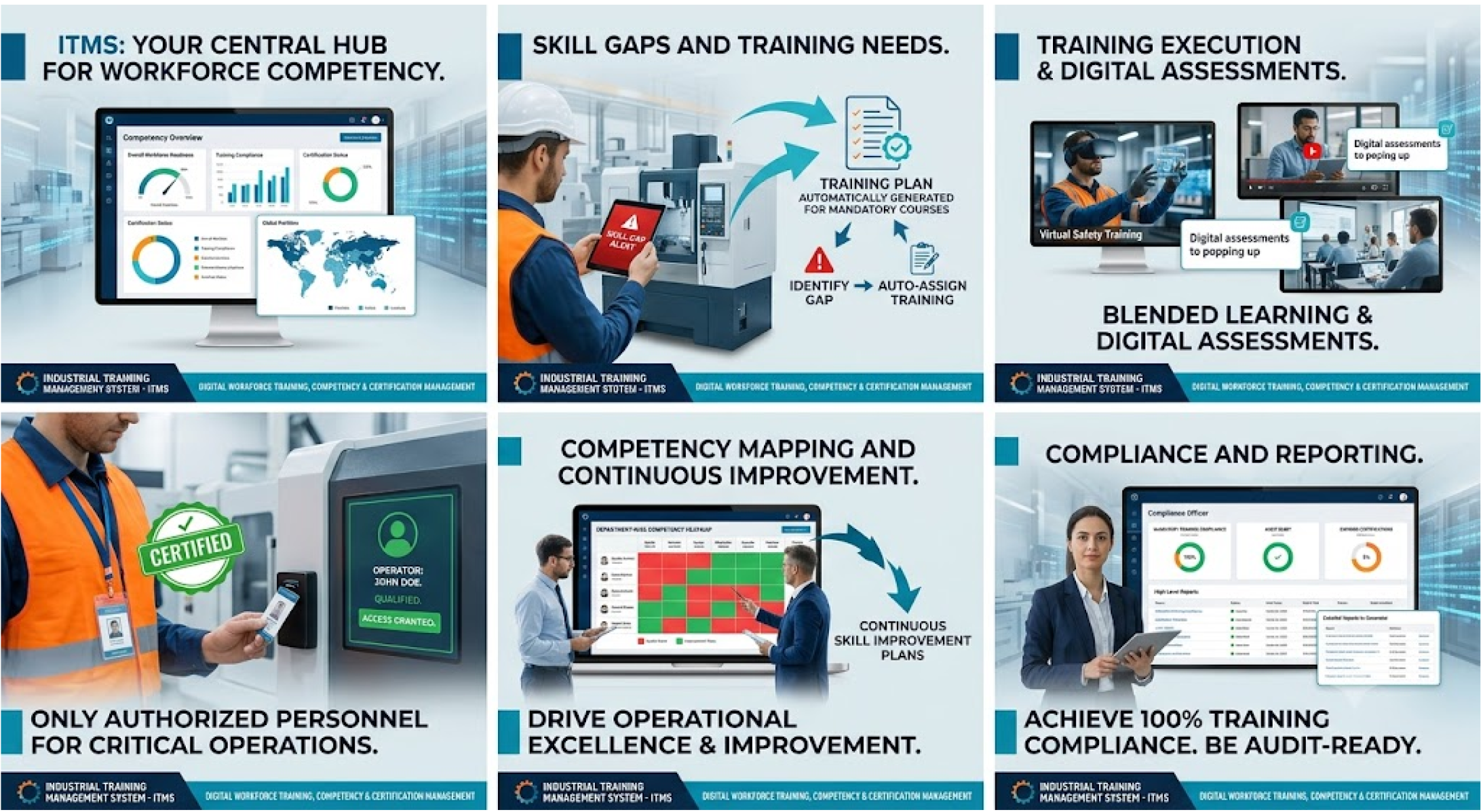
The Industrial Training Management System (ITMS) is a centralized digital platform designed to manage the complete employee training lifecycle—from training-needs identification and planning to execution, assessment, certification, competency evaluation and continuous improvement.
Start with One Machine Request a Demo

The Solution

provides management with a real-time view of

farm equipment manufacturing solutionEmployee training status
farm equipment manufacturing solutionSkill and competency levels
farm equipment manufacturing solutionTraining requirements
farm equipment manufacturing solutionTraining effectiveness
farm equipment manufacturing solutionSkill gaps
farm equipment manufacturing solutionExpiring qualifications
farm equipment manufacturing solutionDepartment-wise competency
farm equipment manufacturing solutionRole-wise competency
farm equipment manufacturing solutionMachine/operator authorization
farm equipment manufacturing solutionTraining compliance
farm equipment manufacturing solutionWorkforce readiness
The system can integrate with HRMS, MES, ERP, QMS, LMS, attendance systems and production systems, creating a connected workforce-management ecosystem.
farm equipment manufacturing solution


Business Context

Manufacturing organizations operate with a diverse workforce consisting of:

farm equipment manufacturing solution Production operators
farm equipment manufacturing solution Maintenance engineers
farm equipment manufacturing solution Quality inspectors
farm equipment manufacturing solution Supervisors
farm equipment manufacturing solution Technicians
farm equipment manufacturing solution Warehouse personnel
farm equipment manufacturing solution Safety personnel
farm equipment manufacturing solution Contract workers
farm equipment manufacturing solution New employees
farm equipment manufacturing solution Apprentices and trainees

Each role requires specific technical, operational, safety and behavioral competencies.

For example, a CNC operator may require training on: Machine Operation → Work Instructions → Quality Inspection → Safety → Tool Handling → Process Parameters → Troubleshooting

Similarly, a maintenance technician may require:
Electrical Safety → PLC → Drives → Preventive Maintenance → Troubleshooting → LOTO → Machine-Specific Training

Managing these requirements manually becomes difficult as employee count, departments, machines and locations increase.


Case Study
Manufacturing Organization

Industry: Discrete Manufacturing
Workforce: 1,000+ employees and contract workers
Facilities: Multiple production departments

Operations: 3-shift manufacturing
Training Types: Technical, Safety, Quality, Process and Compliance

Existing Environment
The organization was managing training activities using a combination of:

Excel spreadsheets
Paper-based training records
Email communication

Manual training calendars
Individual department records
Physical certificates

Manual competency matrices

Existing Business Challenges

Fragmented Training Records
  • Employee training information was maintained across different departments and files.
  • Management had difficulty obtaining a single consolidated view of workforce competency.
Manual Training Matrix
Skill matrices were manually updated, resulting in:
  • Data duplication
  • Incorrect status
  • Delayed updates
  • Version-control problems
  • Difficulty identifying skill gaps
Certification Expiry
  • Mandatory certifications such as safety, electrical, equipment operation and other qualifications were tracked manually.
  • This increased the possibility of missed renewal dates.
Inconsistent Training
Different departments and trainers followed different training methods.
This created inconsistency in
  • Training content
  • Assessment methods
  • Competency evaluation
  • Training records

Similar challenges have been reported in manufacturing organizations where different facilities used Excel, paper and other disconnected methods for training records.

Difficulty in Identifying Skill Gaps
Management could not easily answer:
  • Which employees are qualified for a particular machine?
  • Which employees need additional training?
  • Which department has the highest skill gap?
  • Who can replace an operator during absence?
  • Which critical skills are available on each shift?
Audit Preparation
During ISO, customer or regulatory audits, teams had to manually collect:
  • Training records
  • Attendance sheets
  • Assessment results
  • Certificates
  • Competency records
  • Training effectiveness reports


Proposed Solution
The Industrial Training Management System provides a centralized platform for managing

Employee → Role → Skill → Training → Assessment → Competency → Certification → Authorization → Reassessment

The platform establishes a single source of truth for workforce capability. Core Concept

Right Person + Right Skill + Right Training + Right Certification + Right Job

Training Master

Create a centralized library of all training programs.

Technical Training

Machine operation
PLC
Robotics
CNC
Electrical
Pneumatics
Hydraulics
Maintenance

Quality Training

Quality inspection
SPC
5S
Kaizen
Root-cause analysis
Quality standards

Safety Training

PPE
Fire safety
First aid
LOTO
Emergency response
Machine safety

Process Training

SOP
Work instructions
Process parameters
Changeover
Inspection procedure

Soft Skills

Leadership
Communication
Team building
Problem solving


Training Requirement Matrix
The system automatically identifies required training based on

farm equipment manufacturing solutionJob role
farm equipment manufacturing solutionDepartment
farm equipment manufacturing solutionMachine
farm equipment manufacturing solutionProcess
farm equipment manufacturing solutionSkill
farm equipment manufacturing solutionGrade
farm equipment manufacturing solutionLocation
farm equipment manufacturing solutionRegulatory requirement

Example

Role Required Training Frequency
CNC Operator Machine Operation Initial
CNC Operator Safety Annual
CNC Operator Quality Inspection Annual
Maintenance Engineer Electrical Safety Annual
Maintenance Engineer PLC Troubleshooting Initial
Supervisor Leadership Annual


Training Planning & Scheduling

Training managers can create annual, monthly or weekly training plans.

Features

Training calendar
Trainer allocation
Participant selection
Training venue
Online/offline mode
Training duration
Batch creation
Shift-wise scheduling
Department-wise planning


Competency Management
The competency module converts training completion into measurable workforce capability.

Competency Levels

Level Description
L0 Not Trained
L1 Awareness
L2 Trained / Supervised
L3 Competent / Independent
L4 Advanced
L5 Trainer / Expert

This approach goes beyond simply recording whether an employee "completed training"; manufacturing competency systems increasingly distinguish between training completion and actual operational capability.


Skill Matrix

The digital skill matrix provides a real-time view of workforce capability.

Example

Employee CNC PLC Quality Safety Maintenance
Employee B L3 L3 L3 L4 L3
Employee A L2 L1 L3 L3 L1

Management can immediately identify:

Critical skill gaps
Multi-skilled employees
Training requirements
Backup resources
High-risk competency areas


Certification Management
The system manages employee certifications and licenses.

Forklift license
Crane operator certification
Electrical authorization
Welding certification

Safety certification
First-aid certification
Machine authorization
Customer-specific certification


Assessment Management

Training effectiveness can be evaluated using:

Knowledge Assessment
  • Multiple choice
  • True/false
  • Questionnaire
  • Online examination
Practical Assessment
  • Machine operation
  • Troubleshooting
  • Safety demonstration
  • Process execution
Supervisor Assessment
  • On-job observation
  • Performance evaluation
  • Competency verification


Training Effectiveness
The system measures whether training actually improved employee capability.

Key Parameters

Pre-training score
Post-training score
Practical assessment
Supervisor feedback

Performance improvement
Competency improvement
Retraining requirement


Skill Gap Analysis

The platform compares Required Skill Level vs Current Skill Level, enabling the training team to prioritize training based on business criticality.

Example

Skill Required Current Gap
CNC Operation L3 L2 1
PLC L3 L1 2
Quality Inspection L3 L3 0
Safety L4 L3 1


SOP & Work Instruction Training
Training can be linked directly to controlled documents.

SOP Revision 03 → Assigned to: CNC Operator – Line 2 → Employee reads / attends training → Assessment → Competency verification → Training record generated

This also helps ensure employees are trained against the correct revision of procedures.


New Employee Onboarding

The platform provides structured onboarding, starting on Joining Day:

Employee Profile Created → Role Assigned → Mandatory Training Generated → Safety Training → Quality Training → Process Training → Machine Training → Assessment → Competency Approval → Independent Work Authorization

This reduces dependence on manual onboarding checklists.


Contractor Training Management
The same platform can manage contractor workforce training.

Contractor Features

Contractor master
Worker registration
Site induction
Safety training

Skill verification
Certification
Validity tracking
Access authorization

Training history
Overall training compliance %
Competency %
Skill gap %

Training hours
Certification compliance
Overdue training
Expiring certification

Department performance


HR Dashboard

Employee training status
New joiner training
Mandatory training
Training hours
Department-wise compliance


Before vs After Digitalization

Area Before After ITMS
Training Records Excel/Paper Centralized
Skill Matrix Manual Digital/Real-time
Certification Manual tracking Automated
Training Alerts Manual Automatic
Competency Difficult to verify Real-time
Audit Preparation Time-consuming Instant reports
Skill Gap Manual analysis Automated
Machine Authorization Manual Competency-linked
Onboarding Checklist based Workflow based
Management Visibility Limited Dashboard
Contractor Training Separate records Centralized
Training Effectiveness Difficult to measure KPI-based


Expected Business Benefits

The implementation of an Industrial Training Management System can provide:

Operational Benefits
  • Improved workforce readiness
  • Faster employee onboarding
  • Better multi-skilling
  • Improved machine authorization
  • Reduced dependency on individual trainers
Quality Benefits
  • Standardized training
  • Improved process adherence
  • Better SOP awareness
  • Reduced competency-related errors
Compliance Benefits
  • Centralized training evidence
  • Certification expiry monitoring
  • Audit-ready records
  • Improved traceability
Management Benefits
  • Real-time workforce visibility
  • Skill gap analytics
  • Training ROI measurement
  • Data-driven training planning


Key Performance Indicators
The following KPIs can be monitored:

Training Compliance %
Completed Mandatory Training ÷ Total Mandatory Training × 100
Competency Coverage %
Qualified Employees ÷ Required Employees × 100
Certification Compliance %
Valid Certifications ÷ Total Required Certifications × 100
Training Effectiveness %
Employees Achieving Required Competency ÷ Employees Trained × 100
Skill Gap %
Employees With Skill Gap ÷ Total Employees × 100
Average Training Hours
Total Training Hours ÷ Number of Employees


Success Criteria

The project will be considered successful when the organization achieves:

1. Single Source of Truth
All employee training and competency information available centrally.
2. 100% Training Visibility
Management can identify completed, pending and overdue training.
3. Real-Time Skill Matrix
Competency levels available by employee, role, department and machine.
4. Automated Certification Tracking
Expiry dates monitored automatically.
5. Audit Readiness
Training evidence available through digital reports.
6. Workforce Readiness
Supervisors can identify qualified employees for critical operations.